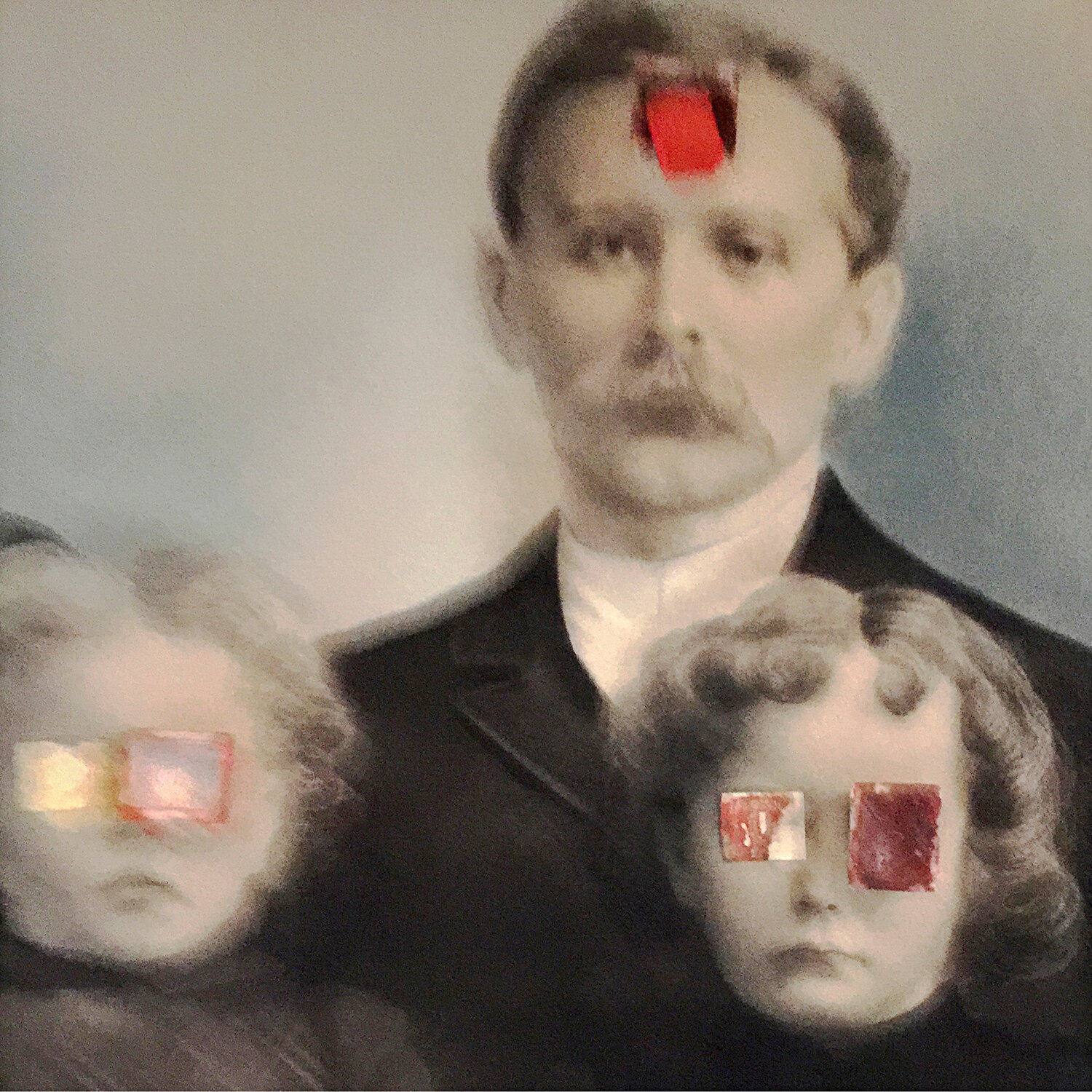
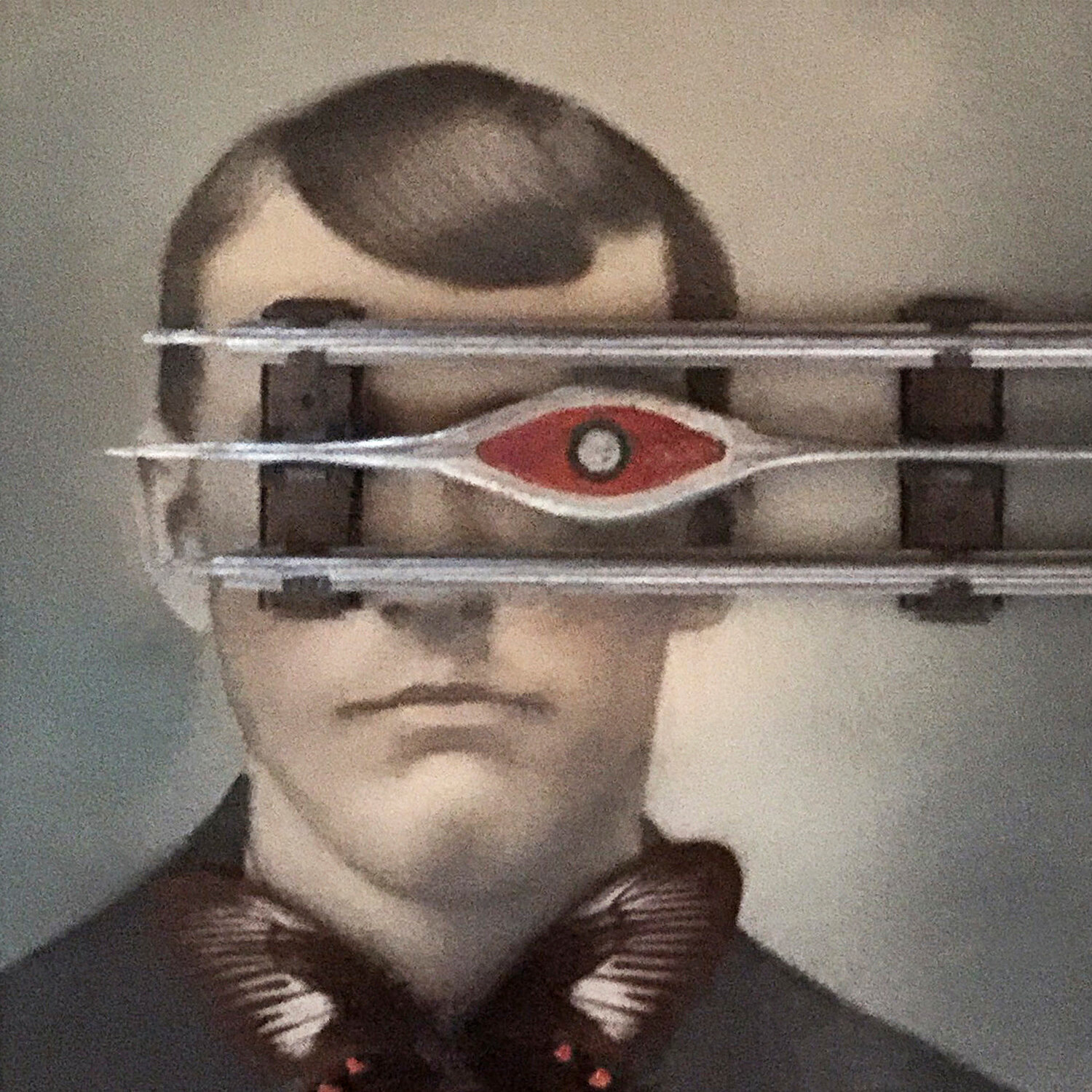
Carlos Fresquez is a Chicano painter, media artist, and celebrated educator. He was born in Denver’s Fitzsimmons Army Hospital in 1956. After graduating from Lincoln High School he earned a BA in 1980 at Metro State University (then Community College) and an MFA at CU Boulder (1995). After graduating from CU, he began a three-decade tenure teaching in the Metro State art department (1990-2024). Since his retirement, he has continued making art at his home in SW Denver while producing occasional offsite projects such as murals.
At the Arvada Center this fall, 2026, I viewed Alter Para Mi Abuelo, Fernando Fresquez (above), an alter made by Carlos to honor his grandfather, Fernando Fresquez. I immediately recognized that for many of the reasons we discuss below, it would fit perfectly into a show I’m curating to open next January in Denver in the Legacy Building gallery, National Western Center. Titled Leave Your Hat On, the show also features works by the photo-realist painter Monique Crine plus photographers Sandy Hume and Gabriela Hasbun.
Carlos has exhibited his drawings, prints, installations and paintings in over thirty US venues and in more than a dozen countries. In Denver in 2018, the Center for Visual Art hosted Carlos Frésquez: Sangre Colorado, a retrospective that critic Michael Paglia described as “a gloriously over-the-top survey.” Recent exhibition venues include the Emmanuel Gallery, Arvada Center, and currently MCA Denver. In March 2027, a solo show of work by Carlos will open at the Kirkland Museum in Denver.
I spoke with Carlos at his home in southwest Denver late July 2026.

Carlos Fresquez: Alter Para Mi Abuelo, Fernando Fresquez. Mixed media with my grandfather’s 1930 saddle, 1998/2026. Fresquez Family Collection.
Rupert Jenkins: Among other things, your alter includes photographs, hand-crafted objects, a vintage saddle and a hat, all offset by a vividly-colored sarape. Is that the kind of thing your grandfather would've worn as a ranch hand a hundred years ago?
Carlos Fresquez: No, it wouldn't be anything as nice. My grandfather herded cattle from Northern New Mexico and Southern Colorado and back and forth for different ranch owners. They probably had a pack on the back of the horse, a sleeping bag of some sorts, and then of course, gear and clothing set for whatever weather they had to contend with. And so I'm assuming if it was winter he'd really be dressed up warm and in the summer or rain, he’d be prepared for all that.
RJ: He was an itinerant vaquero?
CF: I guess he was hired by ranch owners to work for them, to move the cattle from one place to the other, to different grazing locations. So, as my grandmother told me, he'd be gone for several weeks to months even, just either taking them to sell or to graze.
RCJ: Where was his home?
CF: At the time [1920s until the early 1950s] they lived in Southern Colorado in Del Norte, Colorado, South Fork, Colorado, all in that area, depending on the ranch that would hire him.


Left: At Paulson Ranch west of Del Norte. Summer of 1949. Note: Riding Rosie is Ricardo Fresquez (left), youngest brother of Fernando Fresquez who is riding Esther. Fernando was working for The Cattlemens Assoc. and stayed in cabin at Embargo Creek area from May thru September. Right: Marriage of Fernando Fresquez (at left) and Lorencita Quintana, August 1920. Note: First child born April 25, 1927 Maclovia (Maggie) Fresquez, now Archuleta. Second child born Oct. 29, 1933. Carlo Fresquez (Near Southfork, CO) (actual birthplace Bear Creek).
RJ: Do you have strong recollections of Fernando?
CF: My grandfather, he was such a stoic man and he was tall. He was probably a little over six feet. And then with his hat, he always looked taller. By the time he was in his seventies, he was still working on ranches with his brother in Southern Colorado and around Del Norte, South Fork, because I think that's where his brother lived—he'd go help him chop wood and herd the cattle or whatever needed doing. But I just remember him as always so kind. His first language was Spanish, born and raised in Las Vegas, New Mexico. Definitely a US citizen, right? From families that go back centuries. His parents were probably actually in Mexico at the time before the border crossed over in 1848 [the Guadalupe-Hidalgo Treaty, when Mexico ceded vast tracts of Southwestern land to the US.]
RCJ: You’ve placed photographs on either side of the alter. Can you talk about those?
CF: Yeah. I was told some photographer came through documenting the West – back in the 1920s, I guess. I have the original photographs but I didn't want to use them [for the alter]. I just printed these in a sepia photocopy so I could mount them onto board. And then I kind of scratched them up to give them a little vintage look.
[Looking at the wedding photo] This is my grandfather, the tall figure on the left, and my grandmother. And then these [on the right] are the people that witnessed. I'm not sure where they got married. They were from New Mexico. My grandfather was from Las Vegas, New Mexico, and my grandmother was from Pecos, New Mexico.
RCJ: And they just happened to get married when the photographer was there?
CF: I don't know. They might have hired a photographer to take the wedding picture or just someone with a camera took the picture. I don't know.
RCJ: So it's not necessarily the same photographer for all these pictures.
CF: Exactly. Exactly.
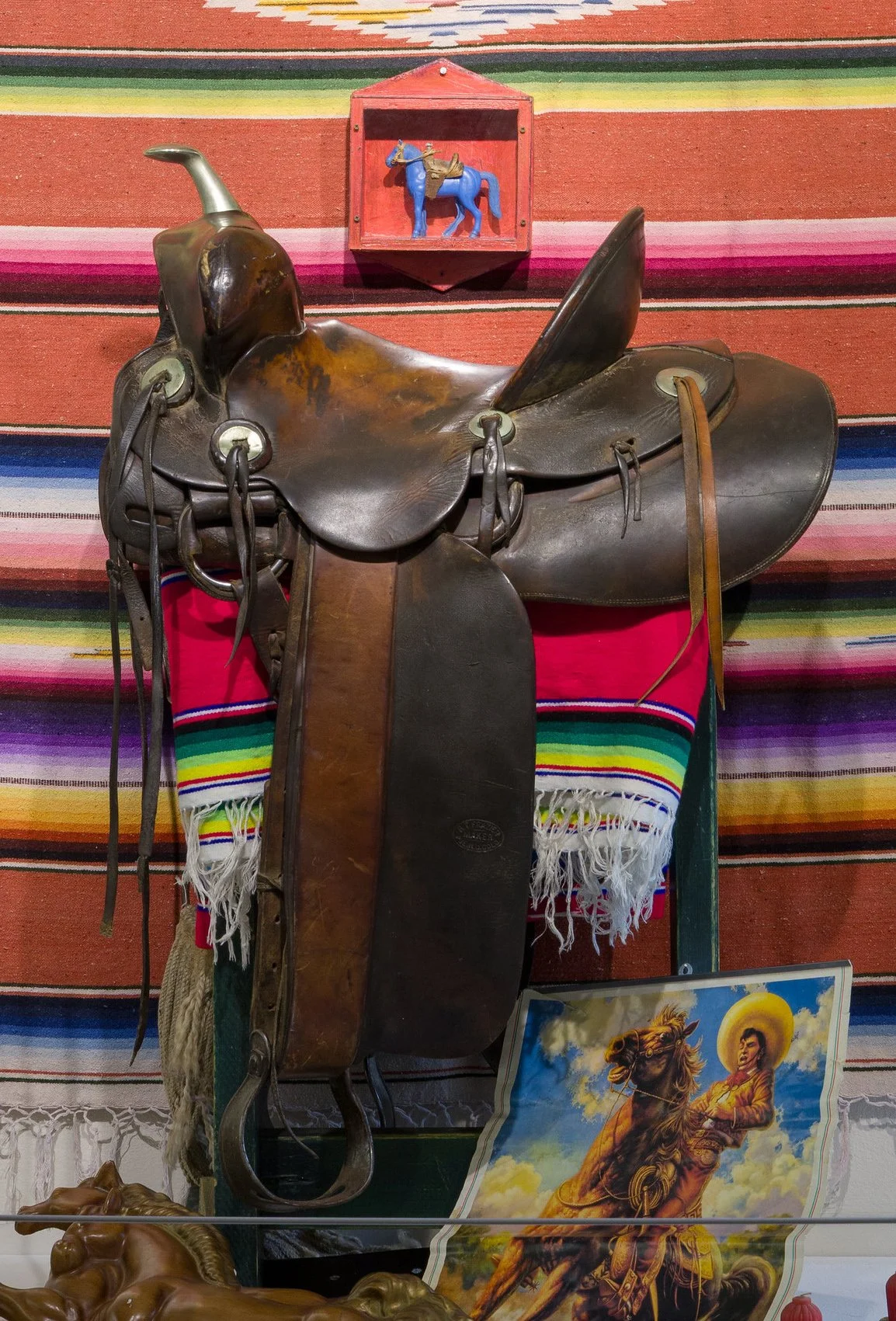
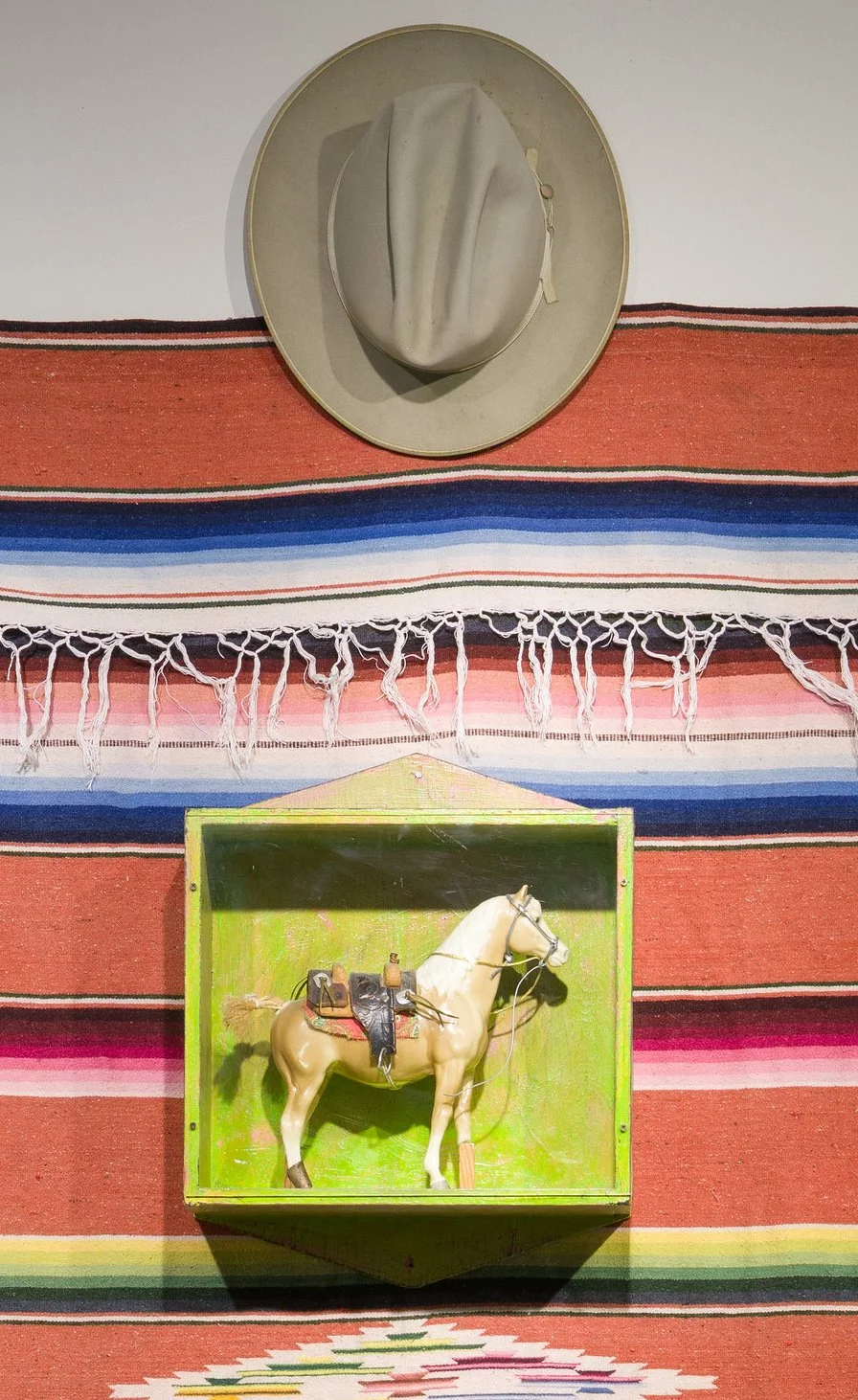
RCJ: In the center of the alter you’ve placed two small horses in boxes.
CF: Those are the toys I had as a kid. When I was a child, maybe eight, nine years old, my grandfather went to the thrift store and found these toy horses. And then he actually got a belt and cut the leather and made a saddle. For the stirrup, I guess, he used the pop tab from an old can. I made the boxes to keep them up. They collect so much dust and I just wanted to honor them and not lose them.
RCJ: And the real saddle is his original saddle?
CF: The saddle is his working saddle from 1930. There's a stamp on there and I think it says it's made in Pueblo.
RCJ: It's in beautiful condition.
CF: Yeah, I always thought I should protect it. It was his working saddle and on the back of it he put his initials, “FF,” Fernando Fresca. At the base [of the alter] is an old calendar I found in Mexico on my travels. The last piece, I guess, is a plaster cast of two horses. My grandmother and grandfather had that hanging on the wall in their home. And on the back he actually put a brand, two Fs. One F's facing this way and the other's inverted going the other way. So he made his own brand.
RCJ: Nice. And the hat?
CF: That's his original hat. He didn't wear this actual one when he was herding cattle [but] he always wore a hat. When he died in 1974, I asked if there's any stuff I could have of his. And my parents said, "Oh yeah, here's this hat." Luckily they had it in a hat box, so it's been saved since 1974. Fifty years.


Left: Picture taken on Falk Bro. ranch, west of Del Norte, CO. June or July 1949. Back to camera: Fernando Fresquez, age 49. Carlo Fresquez, age 15, holding reins (horse is Rosie). Born Oct. 29, 1933. Right: Branding calves in Tercio, CO. Spring of 1929. Fernando Fresquez, born May 30, 1900, age 28 or 29, in checkered shirt.
RCJ: You've shown this alter piece a lot. When did you first make it?
CF: I initially created it probably thirty years ago. I think it was for the Children's Hospital. I had a little placard to the right of the installation, and I found little notes tucked in it. People would be like, "Oh, my grandfather was a cowboy and he herded cattle and I love this story." I just found that really interesting that people would want to comment and share their story.
I’ve always liked adding this [storytelling] element to it because a lot of cowboys were Mexicans and African Americans and the people that owned the ranches were usually white. They had their children help on the farmer ranch as well, but then the hired hands would be the lower class. So it's typically the Blacks and the Mexican Americans that were the workers.
A lot of English cowboy words are very similar in Spanish. Lasso in the Spanish is very much the same. Arena is sand; and that's where they would hold competitions, in the arena or the sand. Even the dances and the clothing – you look at square dancing and the clothing that the Mexicans would wear and the way they would dance, they [white cowboys] just took pretty much everything from the Mexican cowboy. So when I've heard derogatory comments from racist cowboys to Mexican Americans, it's like, "Well, you're carrying this history from the Mexican and you don't even realize it.” So that's why, when I put this installation together, I thought I definitely need to show a word chart with it (below).

RCJ: How do you identify as an artist, ethnically? Chicano, or Mexican American, Latino?
I'll take any, whatever. Actually my genealogy goes back to the first settlements in Santa Fe, when the Spanish Viceroy in Mexico City sent two brothers from Flanders to New Mexico to look for minerals. The Native people had the Pueblo Revolt and chased them back to either El Paso, Juarez, or even further down to Chihuahua. Twenty years later, one of the brothers stayed down there and the other one came back up into Santa Fe, and that was my lineage. That was in the 1600s.
Our DNA group shows that we're also Native – I have 50% Indigenous ancestry from the Pueblo people in Albuquerque, Santa Fe, and then the European part, But I consider myself a Chicano artist because I came out of that time period where I attended my first protest at thirteen-years-old. One of my friends, Sidney Martinez, his dad was part of the Crusade for Justice here in Denver. And so he asked me, "Do you want to go to the Crusade for Justice?" Well, what's that? And here I'm thirteen. There's all this racism in school, which I experienced, and he goes, "This is to fight that. They're looking for justice for all people." So I started attending these meetings and helping make protest banners and stuff until probably high school. So that really affected me as a kid.
RCJ: Were you making art then?
CF: I've always just wanted to do this, be an artist. When I started in high school preparing for college I would just focus on drawing and painting, mostly painting. Lincoln High School had really good art program back then – they had all the disciplines, jewelry, ceramics, metal, wood shop, plastic, mold and bent, plastic, sculpture class. I mean, you name it, you could do it back then.
I started getting very Latino focused, or Chicano focused, on my artwork that I created in high school. Here in Denver, when I heard Corky Gonzalez from the Crusade of Justice say things like, "We're told that we're lazy as Mexicans, we're worthless, we're dirty, blah, blah, blah, and call these derogatory names, we are not that. We come from great civilizations and so on and so forth," I started creating these little Aztec deities or Indigenous forms – those are the kind of things I was looking at to be empowered. And then when I got to college, I just focused on pretty much on painting.
RCJ: Who was your teacher in college?
CF: His name was Bill Hayes, Charles William Hayes. He went by Bill Hayes. And he was a color field painter, completely the opposite of me. He was painting with squeegees. His color was very much like Monet, but it was all translucent. He'd do like sixty layers - it looked like waves of water almost. He was very supportive. [At first] the drawing teacher, Jean Schiff, was so harsh and cruel with her critiques. My first day of class, it was just like, God, I can't handle this woman. And after I worked with her probably three or four semesters, she just took me under her wing and said, “You are amazing. You can do this.” She just really pushed and guided me and prepared me to be a practicing and surviving artist. And so she became almost a second mother in a way.
RCJ: Would you think of her as a mentor then?
CF: Yeah. Yeah, definitely. Definitely. She taught me all these techniques and I would just stay after class if I could, or if there was no other class afterwards. And then I'd go in on weekends and on my own time and just live there. I lived on campus for a long time.
RCJ: You’ve talked about Bill Hayes and Jean Schiff as mentors who helped develop your artmaking and career. Several people have told me that you yourself have been a really influential teacher at Metro and you've mentored a lot of young artists.
CF: Yeah. I’m really humbled by that actually because my intent was never to be a teacher. I graduated [from Metro] in 1980 and ten years later, Bill called me up and he said, "Carlos, I have to have back surgery. I want you to substitute for ten weeks and then I'll come back the remaining six and I'll finish up the class." I'm on the old cord phone and I'm like, "No, I really don't want to teach. I don't want to do this, Bill." And my wife's telling me, "Just do it, Carlos. It's ten weeks. What are you worried about? You just exhibited in the Bronx Museum, the Smithsonian, California. You have this experience. Just share that, do it.” So I go to my class, I give the syllabus, talk to them. Okay, that was easy. Day one. Day two, they're actually starting to work. And before I knew it, the ten weeks were over.
Well, I got a call before the next semester and the department chair said, "Carlos, the students that you taught wrote me a letter and said we should hire you as a teacher. I'm going to set you up for a drawing class next semester." So I said, "Okay, just one class." So then I taught that one class and that's when everything just started meshing. And yeah, I met students that still hit me up to this day. I'll be shopping in Meininger's and they'll give me a hug and say, "God, Carlos, you're just an amazing teacher." And all I know is, I was just honest and truthful and there for the students. So it's nice to get that feedback and that you heard it as well.
RCJ: Definitely. Okay. Well, you've given me an awful lot of information and material, so let's call it a day for now and we’ll talk again soon.
END
All images scanned from original photographs; courtesy of Carlos Fresquez. To view Carlos’s work visit carlosfresquez.com. Leave Your Hat On opens with the annual Stock Show art exhibition in the Legacy Building galleries, National Western Center, January 2027.